
Buyer Guides
First-Article Approval for Custom Epoxy Fiberglass Insulation Tubes: From Sample to Repeat Order
Learn how OEM buyers can review custom epoxy fiberglass tube samples, drawing revisions, inspection evidence, assembly trials, and repeat-order acceptance.
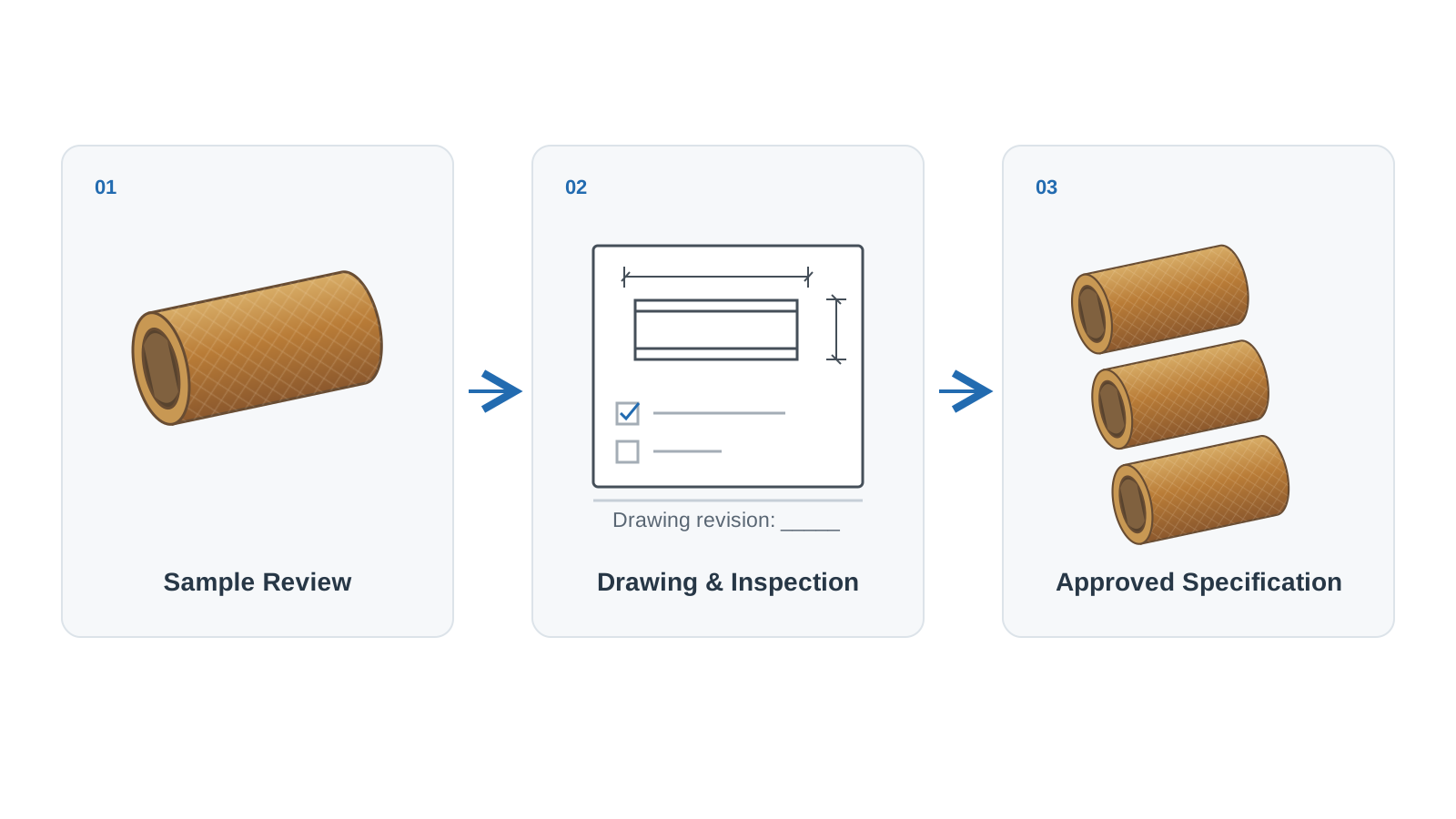
A custom epoxy fiberglass insulation tube that fits one trial assembly is not automatically ready for repeat purchasing. Before approving an order, OEM buyers should agree on the sample's drawing revision, critical dimensions, intended assembly checks, and evidence required for acceptance. A first-article review confirms the component against an agreed specification before repeat purchasing.
The aim is to keep the approved sample, production drawing, and delivered batch aligned.
1. Decide What the Sample Must Prove
Not every sample answers the same buying question. A short tube section can check bore fit. A finished sample can check assembly position. Neither proves final equipment performance.
| Review stage | Main question | Appropriate evidence |
|---|---|---|
| Material or geometry screening | Is this construction worth further evaluation? | Material description, indicative dimensions, sample observations |
| Finished-part first article | Does the tube match the controlled drawing? | Agreed dimensional and visual inspection, drawing revision |
| OEM assembly qualification | Does the assembled equipment meet its requirements? | Customer-defined assembly tests and acceptance records |
Choose the stage first. A generic cut-off cannot replace a finished machined sample. Review WEENOOR's epoxy fiberglass tube products for supply scope.
2. Control the Drawing and Delivery Condition
Start the first-article package with one identified drawing revision. Show ID, OD, wall thickness, length, end condition, and any holes, slots, shoulders or bore features that affect assembly. Mark critical acceptance dimensions.
Also state the required product condition: cured tube blank, cut-to-length tube, or finished machined component. Identify downstream OEM machining or surface preparation.
Material construction matters too. Specify the required glass-fiber/epoxy system or other approved material description without assuming that two visually similar tubes are interchangeable. Define separate methods and criteria for required performance tests.
For detailed tolerance notation, use the existing dimensional tolerance guide. Avoid applying unnecessary tight tolerances to every dimension.
3. Make Inspection Evidence Match the Decision
Review features that could prevent assembly or cause rejection. Decide which dimensions need measured results, which visual conditions need photos, and whether a material identification or other record must accompany the sample.
For example, an end-fitting application may require bore-fit and end-face checks, whereas a simple spacer may have a different set of acceptance points. Define relevant datums and inspection expectations.
Distinguish a supplier's dimensional and visual inspection from any special laboratory testing. Additional reports, traceability, or witnessed inspection are not automatically included; they should be agreed before the order. WEENOOR's quality approach describes requirement review, dimensional checking, visual inspection, and protected packing.
Preparing a first-article sample for an OEM assembly? Send Your Drawing with the drawing revision, critical features, intended trial, quantity, and requested inspection evidence for preliminary review.
4. Check the Tube in the Intended Assembly
A part can pass dimensional inspection and still reveal a problem during assembly. Review how it enters the mating component, whether finished ends seat as intended, and whether the specified surface condition is suitable for the planned joining or handling process.
Record the trial conditions and observed issues. Distinguish a tube deviation from a mating-part or assembly-process problem. If a feature is modified during the trial, update the drawing before treating the modified part as the approved reference.
Where the application calls for electrical, mechanical, environmental, bonding, pressure, or equipment-level tests, the OEM must define and approve the relevant requirements. A first-article tube inspection does not establish complete equipment qualification, guaranteed dielectric performance, or fitness for every service condition.
For fabrication context, review the current manufacturing process. Assess the sample at the specified delivery stage.
5. Translate Approval into a Repeat-Order Specification
The critical purchasing step comes after the sample works. Capture exactly what was accepted so a later order does not depend on somebody remembering which prototype looked right.
Record the approved drawing revision, material, delivery condition, critical acceptance points, inspection documents, and packaging requirements. Keep sample photos or a retained reference part only if their role and limits are clear; appearance alone cannot replace dimensional acceptance.
Clarify how changes are handled. A different end feature, material system, machining route, or inspection requirement may require engineering review and possibly a new sample. A repeat order should not silently substitute an unapproved detail.
Also distinguish prototype quantity from repeat-order quantity when asking for price and schedule. Tooling, machining setup, inspection effort, and packaging requirements can influence the quotation; no fixed commercial outcome should be assumed.
6. Keep the Next Inquiry Focused
A supplier need not see a confidential complete equipment design. A controlled component drawing and a simplified view of the mating interface may be enough for an initial discussion.
Tell the supplier whether the request is for a trial sample, first-article approval, or repeat purchase against an approved revision. Attach the component specification, identify any open engineering questions, and state the requested quantity and delivery location.
For the wider quotation package, see the custom tube RFQ guide. This article's focus is the approval decision between obtaining a sample and releasing a repeat order.
FAQ
Is a basic cut tube enough for first-article approval?
Only if the purchase scope is genuinely a cut tube and the agreed acceptance points can be checked. If end machining controls assembly, approve a representative finished part.
How many samples should an OEM request?
There is no universal number. It depends on the planned fit checks, destructive tests if required, repeatability assessment, and customer qualification plan. Agree on quantity before quotation.
Does first-article approval mean the tube is certified for high-voltage service?
No. Component acceptance against a drawing is different from application-specific electrical testing and approval of the complete equipment.
Can the production drawing change after a sample is approved?
Yes, through controlled revision and agreement. Review whether the change affects interfaces, material requirements, inspection, or the need for another sample.
Conclusion
A useful first-article process connects three decisions: what the tube supplier must deliver, what evidence supports component acceptance, and what the OEM must verify in its assembly. Once those decisions are documented, repeat-order discussions become clearer.
Ready to move from sample evaluation to a defined purchase specification? Send Your Requirements, including your latest drawing, application context, sample stage, expected quantity, and inspection priorities.